Road Traffic Digital Twin Development Using Autonomous Driving Lv.4/4+ Big Data
자율주행 Lv.4/4+ 빅데이터를 활용한 도로교통 디지털 트윈 개발
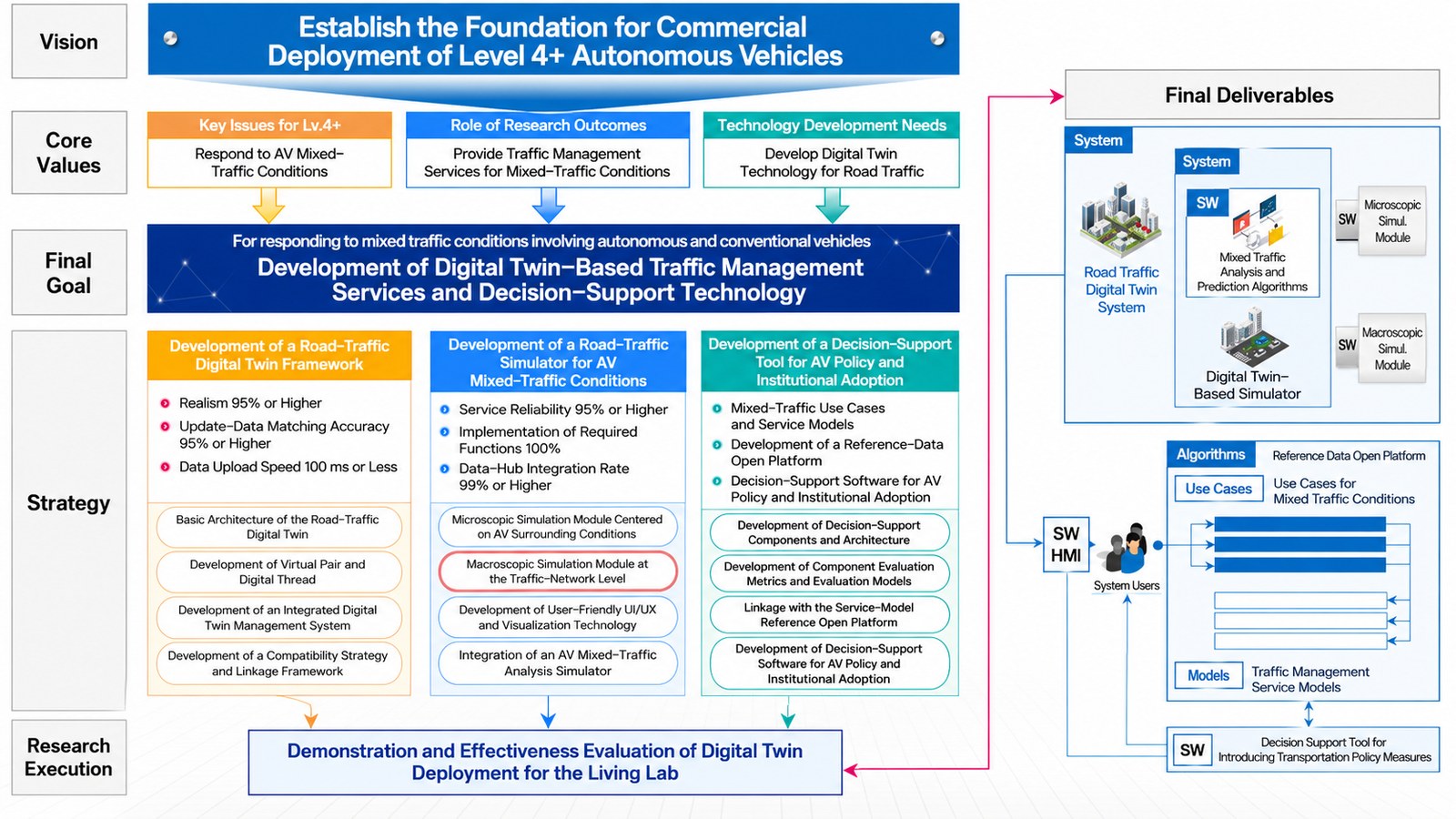
The project develops digital-twin-based traffic management services and decision-support technology for the mixed-autonomy period: extending the limited operational design domain of Lv.4 automated driving to more road types and situations, and simulating road traffic in mixed conditions using big data fused from vehicles and road infrastructure.
It runs in three stages — design and functional development of the road-traffic digital twin system, an analysis and prediction simulator for mixed autonomous-vehicle conditions, and development and verification of the system against a living-lab site.
Why it matters
- At what penetration rate do the efficiency and safety gains from automated vehicles actually appear? The question cannot be answered from today's roads
- If a Lv.4 vehicle receives fused road-traffic information, how does its behaviour change, and can its operational design domain be extended?
- Realistic behaviour models are needed for the Lv.4 vehicles currently under development, and for the traffic operation indicators that follow when they mix with conventional vehicles
- A digital twin for road traffic needs both a framework — construction goal, architecture, entities, services — and a simulation layer, and must interoperate with digital twins built for other domains
KAIST's role
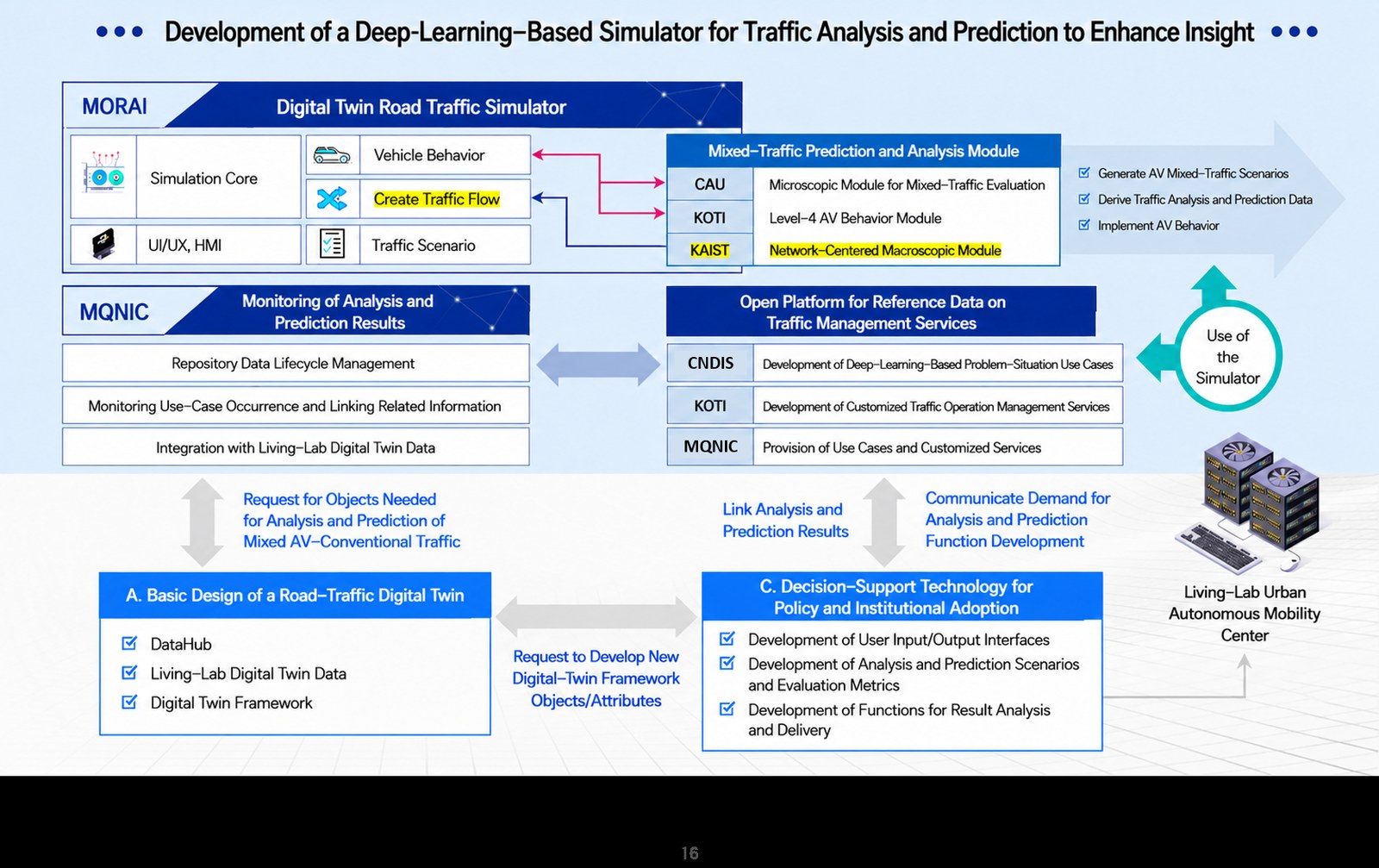
KAIST develops the macroscopic traffic analysis simulation module for mixed autonomous-vehicle conditions — the network-centred macroscopic module in the system architecture, sitting beside CAU's microscopic evaluation module and KOTI's Lv.4 behaviour module.
- From the framework side: services for data fusion and macroscopic analysis model management within the analysis module, on a digital twin platform built for full-lifecycle information linkage
- From the simulator side: a deep-learning-based traffic condition analysis and prediction simulator, implemented as the network-centred macroscopic module
- Data fusion of household travel survey, socioeconomic indicators and supplementary data, with a deep-learning algorithm that corrects travel volume in data-deficient regions
- A multimodal travel assignment model that accounts for automated vehicles and new mobility modes, verified with GEH, RMSE and MSE against existing traffic analysis models
Annual aims
- Stage 1 — simulator architecture for mixed conditions: requirements analysis, comparative analysis of macroscopic model algorithms, design of an AV-aware macroscopic model, then data fusion and construction of AV-aware traffic pattern data
- Stage 2 — macroscopic simulator development: network construction, simulation, travel data input, visualisation and parameter-setting engines; calibration and validation against road traffic volume and travel speed; guidelines for macroscopic analysis under mixed traffic
- Stage 2 — living-lab demonstration: analysis and verification of macroscopic traffic flow for the same period as the demonstration site, a policy support system architecture, and comparative performance evaluation against existing systems
What changes
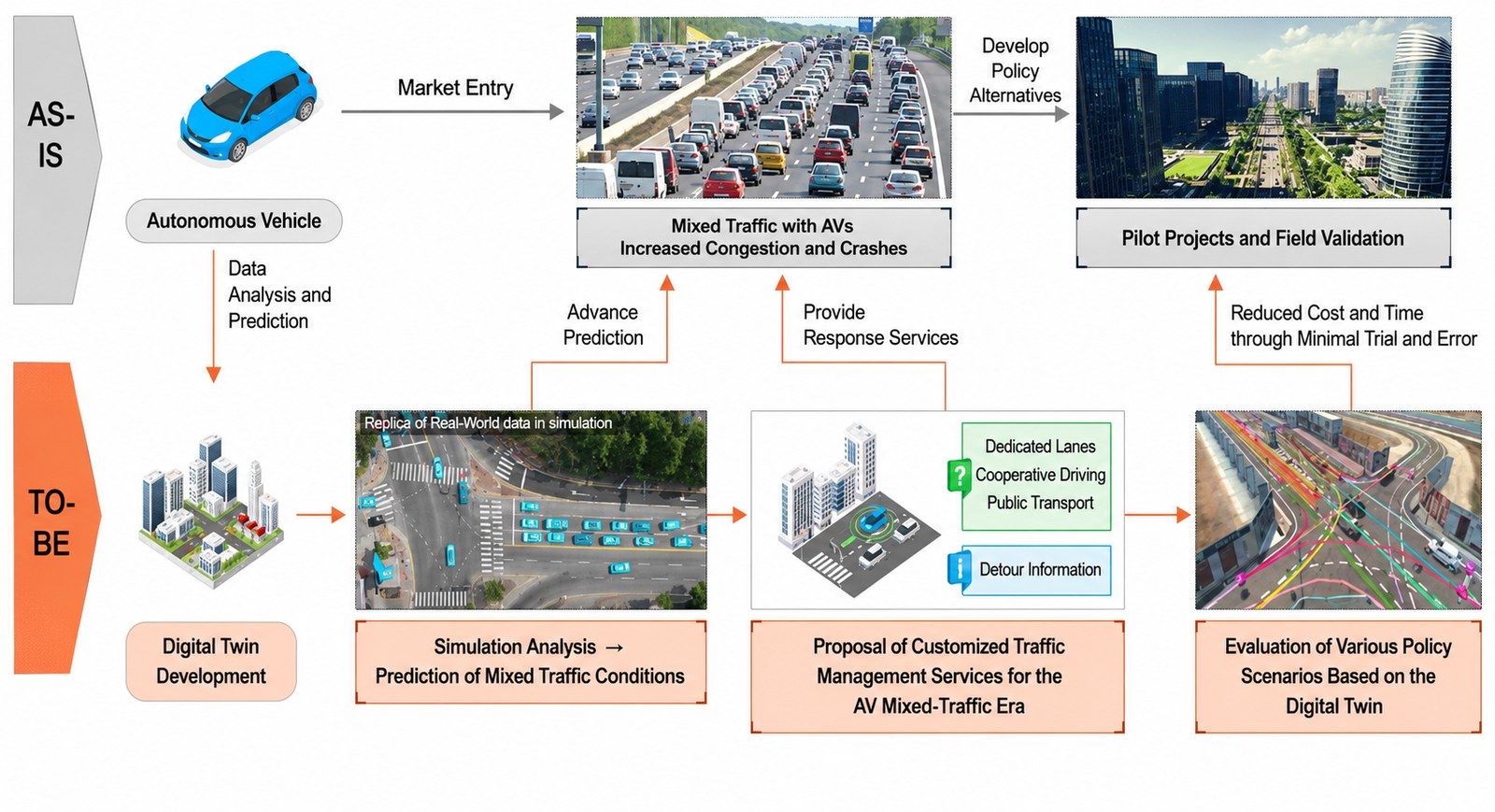
Today an automated vehicle enters the market and the consequences — congestion, crashes — are discovered afterwards, with policy alternatives developed in response. With a digital twin, mixed-traffic conditions are predicted in advance, customised traffic management services are proposed for the predicted problems, and policy scenarios are evaluated in the virtual space before anything is applied on the street, cutting the cost and time of the verification process.
Expected effects
- Source technology for a road-traffic digital twin framework: object modelling libraries for traffic management, a microservice architecture for fast processing of diverse data, and linkage with both microscopic and macroscopic simulators
- Macroscopic analysis that links people's travel-related activities to socioeconomic indicators, improving both the accuracy of demand prediction and the explanation of travel patterns
- Decision support for traffic policy — advance diagnosis of congestion and crash problems, and support for prioritising transport SOC investment in the mixed-autonomy period