Shared Mobility–Mass Transit Operational Plan for Preparing the Next Pandemic
차기 팬데믹 대비 공유 모빌리티-대중교통 운영 계획
COVID-19 changed how people move in ways no earlier pandemic had, and most experts expect another one. This five-year project builds the decision-support tooling a transit operator would need next time: a package that predicts shifting micro-mobility demand, rebalances supply against it, and connects shared modes to mass transit so that demand can be spread rather than concentrated.
Shared bikes and scooters solve much of the first- and last-mile problem, yet their management is still largely driven by experience rather than data. The project treats the shared-mobility and mass-transit pair as one dynamic system and optimises it with deep learning and reinforcement learning.
Five years, five steps
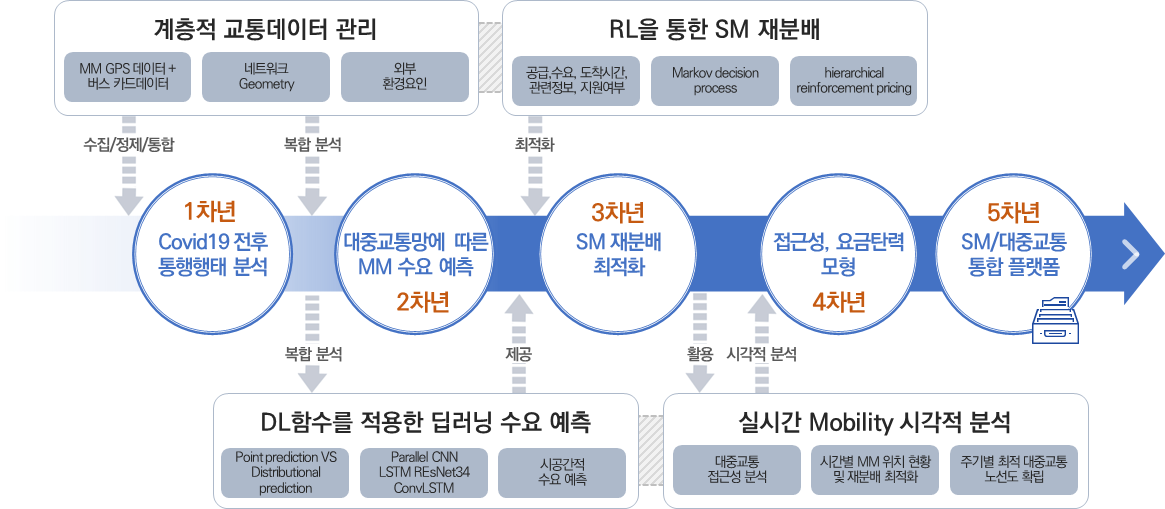
- Year 1 — analyse how COVID-19 changed micro-mobility demand and usage behaviour, and how public transport use shifted with it
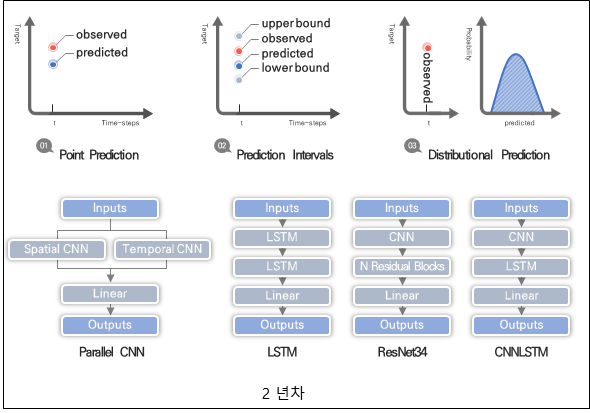
- Year 2 — short-term forecasting of shared-mobility demand using a distributional loss function over neural networks, comparing Parallel CNN, LSTM, ResNet34 and CNN-LSTM architectures
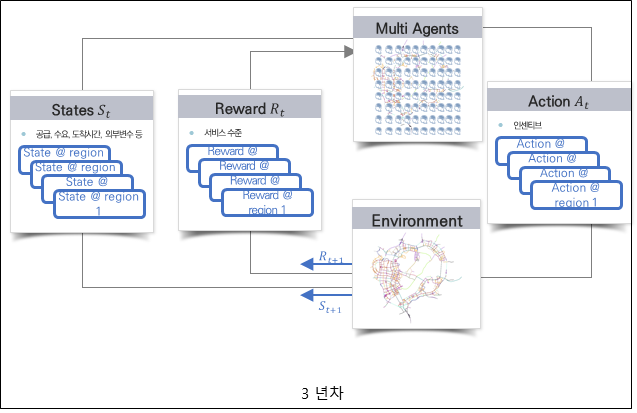
- Year 3 — deep reinforcement learning that rebalances shared mobility against public transport routes and timetables, with service level as the reward
- Year 4 — accessibility between the two systems, redistributing demand through route adjustment and fare incentives
- Year 5 — an integrated package delivered as a web-based service with real-time visualisation
Why the two systems must be planned together
The hypothesis rests on a triple bottom line.
- Social — public transport remains indispensable during a pandemic, so safety and public health require a holistic approach to supplying shared mobility and transit against elastic demand
- Economic — shared-mobility use rises in proportion to transit use, and an elastic fare system that spreads demand across time periods also reduces transmission risk
- Environmental — the climate crisis continued through COVID-19, and promoting public transport remains the most basic thing transport policy can do about emissions
Method
- Hierarchical traffic data management fusing mobile GPS and transit card data, network geometry and external environmental factors
- Distributional prediction rather than point prediction, to capture the physical properties behind demand and identify the parameters that drive it
- A reinforcement learning formulation whose state is supply, demand and predicted arrival and departure times, whose action is user-side shared-mobility availability, and whose reward is total service level
- Accessibility analysis along transit routes and stops, with fare-sensitive reassignment of travel demand